
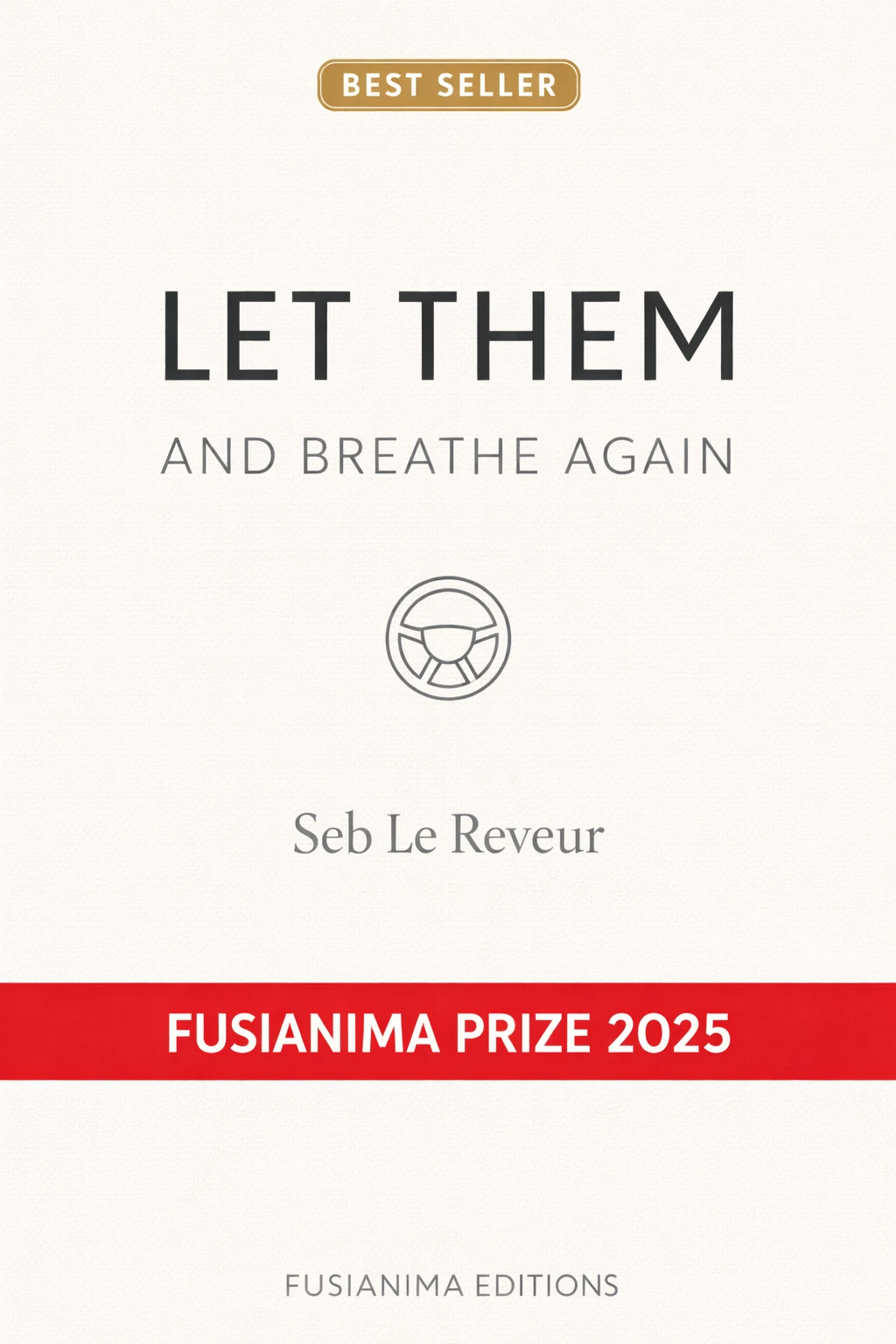
Description
Sommaire
- CHAPTER 1 — THE ILLUSION OF THE STEERING WHEEL
- CHAPTER 2 — THE VOID IS NOT YOUR ENEMY
- CHAPTER 3 — YOUR ENERGY GAUGE IS NOT INFINITE
- CHAPTER 4 — THE LIFE-SAVING MANTRA: « LET THEM »
- CHAPTER 5 — WHAT YOU GAIN WHEN YOU LET GO
- CHAPTER 6 — IF THEY DON’T INVITE YOU, LEAVE THEM
- CHAPTER 7 — YOUR PARTNER IS NOT YOUR RENOVATION PROJECT
- CHAPTER 8 — PARENTS AND FAMILY (THE DIFFICULT LEVEL)
- CHAPTER 9 — THE VALIDATION TRAP
- CHAPTER 10 — SETTING BOUNDARIES WITHOUT BEING A TYRANT
- CHAPTER 11 — THE OFFICE, THAT JUNGLE YOU WILL NOT TAME
- CHAPTER 12 — THE OPINION OF STRANGERS (AND TIKTOK)
- CHAPTER 13 — WHEN LIFE GOES OFF THE RAILS
- CHAPTER 14 — BECOMING AN OBSERVER, NOT AN ACTOR IN THE DRAMA
- CHAPTER 15 — YOUR NEW LIFE AS A “LAISSEZ-FAIRE-IST”
Résumé
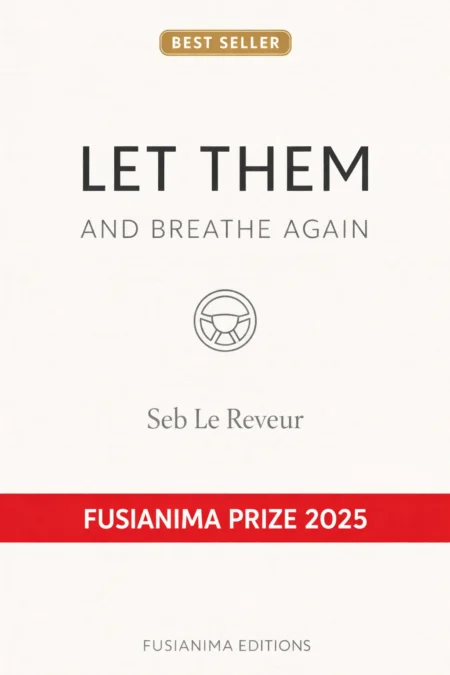
CHAPTER 1 — THE ILLUSION OF THE STEERING WHEEL
Why you are exhausting yourself driving a car that is on railsThere you are, hands clenched on the wheel. Your knuckles are white because you’re squeezing so hard. You’re sweating, watching the curve approach, screaming instructions into the wind, braking on a floor mat that never even had a pedal. You are doing that very human thing: behaving as if your tension were a skill.
As if, because you are stressing so hard, you are going to influence the trajectory.
You tell yourself that if you don’t do this—if you don’t manage this turn with millimeter precision—it’s a crash. A total wreck. The end of the world. A catastrophe. The « I knew it would end like this. »
And it’s crazy because, in your head, it makes sense: the harder you squeeze, the more you control. The more you worry, the more you prevent. The more you anticipate, the more you protect.
Except.
I have a question for you, my friend. A very simple question, but it could save you years of your life (or at least a few nights of sleep):
Have you noticed that the car is on rails?
You can turn that wheel to the left until you dislocate your shoulder. You can crank it to the right while cursing at the sky. The car doesn’t care. It follows the rail. It goes where it needs to go, whether you’re having a nervous breakdown or singing Taylor Swift at the top of your lungs.
The rail is the other person.
The rail is the situation.
The rail is « what is. »And there you are, pretending to be the driver.
You are not the driver of other people’s lives.
You aren’t even the co-pilot.
Often, let’s be honest: you aren’t even in the car.You are in the passenger seat of a movie, tensing up as if you could jump into the screen to stop the character from doing something stupid.
And you are giving yourself a cramp in your arms because you are afraid of the void.
Welcome to: the illusion of the steering wheel.
1) The cockpit of your brain (aka: the engine room)
Before I tell you to « let go, » we need to talk about the real subject. Because « letting go » is pretty, it’s Instagrammable, but your brain doesn’t care. Your brain has a very clear mission: to keep you from suffering.
So it does what it knows best: it simulates.
It simulates the future.
It simulates catastrophes.
It simulates conversations.
It simulates responses.
It simulates the moment you will be humiliated, rejected, abandoned, judged.And while it’s simulating, you confuse simulation with reality.
You think ruminating is thinking.
You think worrying is loving.
You think controlling is protecting.But often, it’s just a sophisticated way of saying:
« I cannot stand uncertainty. »
And careful: I’m not saying this to slap you. I’m saying it because I know you. Because I do it too. And because we are going to stop lying to ourselves.
Control is rarely a proof of intelligence. It is often a proof of fear.
2) The crime scene (we’ve all been there)
Let me tell you about something that happened to me the other day. It was the kind of moment where I should have slapped myself.
I was with a friend, let’s call him Julien. Julien is the kind of guy who systematically makes the worst romantic decisions. The guy has a talent. If there were an Olympic Games for « bad sentimental choices, » he’d be sponsored by a tissue brand.
He’s telling me about his latest debacle: he wants to call his ex back.
The one who blocked him three times. The one who pulled the « I’m coming back » then « actually no » move like it was a Netflix series.And I, instead of listening, empathizing, or saying « I’m here for you, » I go into my favorite mode: savior mode.
For an hour—ONE HOUR of my life that I will never get back—I tried everything.
I pulled out logical arguments.
I asked « intelligent » questions.
I made analogies.
I practically drew a diagram.
I almost said: « Wait, let me make you an Excel spreadsheet with the emotional consequences at 3, 6, and 12 months. »I felt invested with a divine mission: I had to stop him from doing this stupid thing. My heart was beating fast. I was borderline angry that he didn’t understand. Not angry at him, mind you. Angry at the universe for not listening to me, even though I was right. (Yes, it’s ridiculous. Yes, it’s human.)
And do you know what he did the moment we said goodbye?
He pulled out his phone.
And he sent her a text.
Right in front of my eyes.Not in secret. Not later. No: right in front of me. As if I hadn’t spent an hour transforming into the Ministry of Wisdom.
In that moment, I felt that heat rise in my neck. Pure frustration. A mix of: « Are you kidding me? » and « Why do I bother? »
And then, suddenly: the click.
I looked at him, and I said to myself:
« What the hell am I doing? I’m trying to drive his car. »
I wanted to brake for him.
I wanted to turn for him.
I wanted to keep him from hitting the wall.The result?
Me: exhausted.
Him: determined.
The stupid thing: done anyway.That is the illusion of the steering wheel.
We believe our stress is a shield. We believe that if we worry enough, we will prevent the worst. We believe that if we insist, if we explain, if we « hold » the situation, it will obey.
Spoiler: your anxiety is not a customer service department for the rest of the world.
3) Why it feels so real (even though it never works)
If the illusion of the steering wheel sticks to you, it’s because it gives you a very specific feeling: the feeling of acting.
Stress is internal activity. It’s noisy. It moves. It consumes. So your brain says: « Oh, okay, we’re doing something. »
Except you aren’t.
Most of the time, you are just revving the engine while parked.
It’s like staying on a treadmill, pressing the buttons hard, changing the music, gripping the handles… without ever actually starting.
you wear yourself out, but you don’t move forward.
And if you want a slightly cruel truth: sometimes, you prefer being tired over being vulnerable.
Because if you let go, you find yourself face to face with what you’ve been avoiding for a long time:
uncertainty
helplessness
the fact that the other person might disappoint you
the fact that you cannot « guarantee » a result
the fact that you cannot stop someone from making a mistake
And your brain does not like that. Your brain wants something solid. Controllable. Predictable.
It wants a promise.Except life doesn’t sign contracts.
4) Your life is divided into two zones (and you’re in the wrong territory)
We need to get this straight right now. Your life is divided into two zones. It’s simple, it’s silly, but if you get this, you’ve just covered 50% of the path.
Your Zone of Power
This is the place where your steering wheel is actually connected to the wheels. Where an action from you produces a direct consequence.
what you say
what you do
what you accept
what you refuse
your pace
your boundaries
your choices
your way of responding (or not responding)
the attention you give
the energy you spend
the people you let into your living room… and into your head
It’s small, yes.
But it’s already gigantic.The « Let Them » Zone
This is the place where you don’t have the wheel. Where you might have influence, sometimes… but not control. And above all: not guaranteed control.
what your boss thinks of you
the fact that your sister is clinging to a shady guy
the weather
a cancelled train
your mother-in-law’s opinion of your cooking
your friends’ choices
the level of emotional maturity of a 42-year-old adult (who persists in having tantrums like a 6-year-old)
the fact that someone doesn’t answer you
other people’s moods
their ability to hear what you are saying
their willingness to change
When you try to park your car in that zone, you are parking in an emotional handicap spot. You have no business there. You have no grip. And you end up in a rage.
And the worst part?
You end up believing that you are the problem: « Why can’t I handle this? »
But no.
You are just trying to play a game for which you don’t have the controller.5) « But if I don’t control it, it means I don’t care »
I can hear you already.
You’re going to tell me:
« But I do this because I *do* care! If I let my daughter do whatever she wants, does that mean I don’t love her? If I let my boyfriend be messy, does that mean I’m giving up? If I let my team do whatever they want, does that mean I’m lax? »Here is where it stings:
Control is not love. It is fear.
We want to control others so we don’t have to deal with our own discomfort regarding their mistakes. We want them to do « well » (according to our criteria) because seeing someone mess up reflects our own fragilities back at us.
We are addicts to security. We want a life without waves, without the unexpected. So we become everyday dictators.
And careful: I’m not saying « dictator » to judge you. I’m saying « dictator » because that is exactly the mechanism: you want reality to obey your rules, otherwise you suffer.
So what do you do?
You monitor.
You correct.
You « suggest » very strongly.
You say « whatever you want » but you don’t mean it at all.
You manipulate a little (for their own good, obviously).
You fix things behind them.
You repeat yourself.
You over-explain.
You get angry.
You guilt-trip.
You start over.And you call that: « being a good person. »
When really, you are just a tired person.
6) The true cost: you pay with your peace
The illusion of the steering wheel isn’t just a habit. It’s a tax. You pay it every day, sometimes without realizing it.
You pay with:
your nights (hello, brain doing trampolining at 2:14 AM)
your body (rock-hard shoulders, clenched jaw, stomach in knots)
your patience (you become irritable, « thin-skinned »)
your creativity (it’s hard to invent when you’re in survival mode)
your relationships (by trying to control, you suffocate)
your self-respect (because you feel like you are betraying yourself)
And the most unfair part?
You often pay for things… that will not change.You spend an insane amount of energy trying to change someone who has no intention of changing.
It’s like watering a plastic plant and being surprised it doesn’t grow.
7) The rails you refuse to see (because it hurts)
Let’s go back to the metaphor: the car on rails.
Why do you refuse to see the rails?
Because seeing the rails means accepting this sentence:« I cannot control this. »
And your ego experiences that sentence as a humiliation. Your nervous system experiences it as a danger.
But it’s just reality.
The rails are other people’s choices.
The rails are their wounds.
The rails are their limits.
The rails are their addictions, their blindness, their mechanisms.
The rails are their priorities, even when they seem stupid to you.And you, you can:
speak
propose
express
set a boundary
leave
stay
accept
refuse
love
protect yourself
But you cannot take the wheel for them.
Even if you scream louder.
Even if you explain it better.
Even if you love them very much.8) Everyday Theater: where you are driving a car that isn’t yours
Let’s take a little tour, just so you can spot where you are playing driver.
Scene 1: The « Read » receipt
You send a message.
It says « Seen » or has a read receipt.
And then, your brain turns into a Netflix screenwriter.« Why isn’t he answering? »
« Did I say something wrong? »
« Does he not care? »
« He doesn’t respect me. »
« I’m always the one making the effort. »And you refresh your screen as if you could summon a response through the power of your impatience.
The car is on rails, my friend.
The person will answer… or they won’t.
And you are giving away your calm to a blue bubble.Scene 2: The incompetent colleague
You have a colleague who is messing everything up.
You know it. Everyone knows it.And what do you do?
You catch the mistakes. You correct. You anticipate. You compensate.The result: the company thinks « it’s fine. »
The colleague thinks « it’s working. »
And you are burning out.You are driving a car that isn’t yours.
The car is on rails: as long as you keep catching it, the rail continues.Scene 3: The family (the final boss level)
You want your mother to understand.
You want your father to change.
You want your sister to respect herself.And you are fighting against rails that were laid down 30 years ago.
You’ll tell me: « Yes, but it’s my family. »
Exactly. That’s why it hurts so much.But loving is not controlling.
Loving, sometimes, is watching someone make a choice you would never have made… and deciding what you are going to do with that.Scene 4: The couple and the pile of clothes
The pile of clothes.
The classic.You ask.
You repeat.
You threaten.
You tidy up.
You seethe.And deep down, the subject isn’t the fabric.
The subject is: « Why don’t I feel respected? »
« Why am I carrying everything? »
« Why do I feel like I’m alone? »You are trying to drive the pile of clothes, when you should be talking about the rail: respect, distribution, agreement.
9) The truth that feels good: you control almost nothing (and that’s OK)
I’m going to tell you something both terrifying and liberating:
You control almost nothing.
You control your intentions, not the results.
You control your effort, not the other person’s reaction.
You control your way of speaking, not the way the other person hears.
You control your presence, not the gratitude you receive.
You control your choice, not life’s timing.And you know what?
It’s normal. It’s human. It’s the condition.The problem isn’t that you don’t control things.
The problem is that you act as if you do.And it’s killing you slowly.
10) Why you are addicted to control (the real root, the one that follows you everywhere)
We are going to go one step deeper, because otherwise you’ll just tell yourself: « Okay, I get it, I need to relax. » And you’ll… put pressure on yourself to relax. (Yes, you are capable of that.)
The need for control often hides one or more very specific fears:
Fear of being judged
You want everything to be « right » because you don’t want people to think you are useless, irresponsible, or not up to the task.
So you control to avoid shame.Fear of being abandoned
You want everything to go « as it should » because you are afraid the other person will leave, turn away, or forget you.
So you control to maintain a bond.Fear of suffering
You want to avoid mistakes, conflicts, and the unexpected because your nervous system associates them with pain.
So you control to feel safe.Fear of the void (this one is sneaky)
When you stop controlling, what is left?
There is… you.
And sometimes, you don’t know what to do with yourself.
So you control to fill the space.Control is often background noise that keeps you from hearing the silence.
11) Control: an attempt to avoid an emotion
I’m going to tell you a sentence that might follow you for a long time:
You don’t control for the sake of control. You control so you don’t have to feel.
You control so you don’t have to feel:
fear
sadness
helplessness
shame
disappointment
solitude
And as long as you don’t accept feeling these things, you will continue wanting to run the world.
Except the world cannot be run.
So you suffer.
12) The « So What? » exercise (the little hammer that breaks the movie)
Let’s do a test. A real one. Not something theoretical.
Think of that thing that is eating at you right now.
That thing you are trying to control in someone else, or a situation that doesn’t depend on you.Okay.
Now, be brave: let it be. Let the situation be.
And ask yourself:
So what?
Example: « My boyfriend never puts his clothes away and it’s driving me crazy. »
You let the pile grow.
So what?
« Well, the apartment is going to be gross. »So what?
« If someone comes over, I’ll be ashamed. »So what?
« People will think I’m a slob. »So what?
« People will judge me. »So what?
« I will feel like a failure. »So what?
« I will feel unlovable – disrespected – not good enough. »Do you see the pattern?
At the end of the « So what? », we almost always land on:
fear of judgment
fear of not being enough
fear of being rejected
fear of being helpless
The pile of clothes is not what threatens you.
It’s what you believe the pile of clothes says about you.The pile of clothes doesn’t kill kittens.
The world doesn’t stop turning.
The only thing that suffers is your ego which wants everything to be « perfect » and your nervous system which wants everything to be « safe. »And that is where you get your power back: not by controlling the pile… but by seeing the fear behind it.
13) « Yes, but if I let go, everything goes off the rails »
Very good argument. Very tempting. Very common.
And sometimes… a little bit true.There are situations where you are the only adult in the room.
There are situations where if you let go, it becomes dangerous (safety, health, concrete responsibilities).
So no: we aren’t talking about becoming irresponsible here.We are talking about something more subtle:
Stopping spending your energy on what does not respond to your energy.
If you control something and it changes: okay.
But if you control and it doesn’t change, and you do it again, and you exhaust yourself… then you aren’t managing. You are sacrificing yourself for an illusion.And that is when it becomes toxic.
Not toxic for others, first.
Toxic for you.14) The « Steering wheel check »: a question that gives you your breath back
I suggest a reflex. Something simple. Something you can do in the middle of a control crisis.
When you feel the tension rising, when you feel that you want to correct, explain, save, convince, manage… just ask yourself this:
« Do I have a real lever here and now? »
If yes: act (but a clean, clear action, not frantic agitation).
If no: breathe and back off. You are turning a decorative steering wheel.
And careful: « real lever » doesn’t mean « I can force the other person. »
It means: « I can do something that depends on me. »Examples of real levers:
saying how you feel without accusing
setting a boundary (« I am not available for this »)
making a decision (« I’m leaving, » « I’m staying, » « I’m changing »)
asking clearly (not begging, not manipulating)
withdrawing from a drama
stopping answering
stopping fixing things
See?
Power is not « getting. »
Power is « choosing. »15) The « Savior » trap (the glamorous version of control)
Control has a very elegant costume: that of the savior.
You make efforts « for others. »
You give advice « for their own good. »
You anticipate « to avoid problems. »
You carry the load « because otherwise no one will. »And you end up with an imaginary medal, yes.
But mostly with a very real resentment.Because the savior, deep down, is always waiting for something:
gratitude, recognition, a change, a « you were right. »And when that doesn’t happen, they feel betrayed.
Even though they put themselves in that role.
It’s hard to hear, but it’s liberating:
You are not obligated to be the hero of people’s lives.And people didn’t ask you to be their hero.
Sometimes, they just asked you to be there. Just there.
Present. Calm. Human.The savior confuses « loving » with « directing. »
Love is a bond.
Directing is a power grab.16) The « Secret Contract » you sign without knowing it
Here is something you might be doing: signing invisible contracts.
Example:
« If I do everything perfectly, no one can leave me. »
« If I manage everything, I will be loved. »
« If I prevent every mistake, I will be safe. »
« If I am irreproachable, I won’t be criticized. »
« If I make myself indispensable, I won’t be abandoned. »See the logic?
It’s childish in the noble sense: it’s your brain looking for a rule for survival.The problem is that life doesn’t respect these contracts.
You can be perfect and still be criticized.
You can be generous and still be left.
You can be cautious and still have the unexpected happen.And when it happens, you don’t say: « Oh, the contract was false. »
You say: « I didn’t control enough. »So you control more.
It’s like putting more salt in a ruined soup: you think you’re fixing it, but you’re destroying it.
17) The moment you get your dignity back: when you stop negotiating with the uncontrollable
There is a precise instant where your life changes:
it’s when you understand that you don’t need to win against reality.You don’t need to convince the other person to love you.
You don’t need to force a situation to be « fair. »
You don’t need to transform people into improved versions of themselves.You need to see, clearly:
what is
what that does to you
what you accept
what you refuse
what you choose
And to stick to it.
That is real power.
Not the power to direct.
The power to respect yourself.18) Mini toolbox: 4 « best friend » moves when you feel control rising
I’m giving you four simple moves. Not rituals. Moves. Because you don’t need to be mystical, you need to be lucid.
1) The « Stop the movie »
When your brain starts a disaster scenario, say (in your head):
« Stop. I am making a movie. »Not « I am in danger. »
A movie.It brings you back to the present.
2) « Naming the rail »
Identify what you don’t control:
« I don’t control their answer. »
« I don’t control their choice. »
« I don’t control their mood. »Naming it is already letting go a little.
3) The « Self Choice »
Ask:
« Okay. And what am I doing? »Because your power is there. Always there.
4) The « Unhooking » breath
One long exhale. Just one.
As if you were coming out of the water after holding your breath.Your body understands before your head does.
19) What letting go of the wheel is NOT (to avoid misunderstanding)
Because I see you coming: « So I just leave everything, I become passive, I let people walk all over me? »
No.
Letting go of the wheel is not:
becoming indifferent
becoming fatalistic
accepting disrespect
staying in a situation that destroys you
saying yes to everything
denying yourself
Letting go of the wheel is stopping the belief that your stress is a piloting tool.
It is saying:
« I see what you are doing. I don’t agree. I think you are messing up. But I cannot drive for you. »
And then, you take back something essential: your peace.
20) The image that changes everything: the decorative steering wheel
Keep this image: the decorative steering wheel.
There are places in your life where you have a real wheel (your choices, your boundaries, your pace).
And there are places where you have a decorative wheel (other people’s decisions, their maturity, their timing).Suffering comes when you confuse the two.
When you turn a decorative wheel, you have the impression of acting, but you aren’t.
You are just flailing.And flailing is exhausting.
Action is clarifying.21) The lesson of the chapter (to engrave on your mirror)
Let’s engrave something together. Something simple, but powerful:
You are not responsible for the rain.
You are not responsible for human stupidity.
You are not responsible for the choices of an adult who refuses to evolve.You are responsible for yourself.
Letting go of the wheel is not becoming a cynical « don’t-give-a-damn » person.
It is becoming someone damn intelligent.It is choosing to no longer pay for your life with your energy.
Because in truth, you don’t have an infinite supply.
And if you spend your energy on the rails, you have none left for what actually depends on you.22) The ending (and the opening)
I want you to remember one last scene.
Imagine yourself in that car on rails.
Your hands are clenched. You are controlling. You are struggling. You are suffering.Then, at some point… you place your hands on your thighs.
You feel the seat. You feel the air. You feel your breath.The car continues.
And you realize something almost insulting:
The world will continue with or without your tension.
So you might as well choose something radical:
stop giving yourself blisters for nothing.In the next chapter, we are going to look at why you want to regulate everything so much:
the fear behind the control, the one that disguises itself as « I’m just demanding, » « I want the best, » or « I’m just managing. »And I’m warning you: it’s sensitive.
But that is where you get your freedom back.Because happiness—the real kind—is not a perfect life.
It’s what remains when you stop fighting against what you cannot direct.Breathe.
You just let go by one millimeter.And sometimes, a millimeter is the start of a new life.
Avis d’un expert en Bestseller ⭐⭐⭐⭐⭐
Ce texte propose une déconstruction radicale et nécessaire de l’illusion du contrôle. En utilisant une métaphore visuelle puissante — le volant décoratif sur des rails — l’auteur rend accessible un concept psychologique complexe : la différenciation entre notre sphère d’influence et celle d’autrui. La plume est tranchante, empathique et dénuée de langue de bois, ce qui permet de briser instantanément le déni du lecteur. L’ouvrage ne se contente pas de prôner le calme ; il propose une véritable méthode de survie émotionnelle pour les profils hyper-responsables et les ‘sauveurs’ compulsifs. La structure est progressive, partant de la remise en question pour arriver à des outils concrets de ‘débranchement’. C’est une lecture indispensable pour quiconque souhaite retrouver son autonomie émotionnelle et cesser de sacrifier sa paix intérieure pour des résultats hors de son emprise. Note : 18/20. Conseil : Ne lisez pas ce livre d’une traite. Appliquez l’exercice du ‘So What ?’ sur une seule situation irritante dès ce soir pour expérimenter immédiatement la libération mentale qu’il procure.
Note : 18/20
Conseil : Ne lisez pas ce livre d’une traite. Appliquez l’exercice du ‘So What ?’ sur une seule situation irritante dès ce soir pour expérimenter immédiatement la libération mentale qu’il procure.
Questions fréquentes
- Le lâcher-prise signifie-t-il devenir indifférent ?
- Absolument pas. Lâcher le volant ne signifie pas se désintéresser des autres, mais accepter que leurs choix ne sont pas sous votre contrôle. Vous restez présent, mais sans porter le fardeau de résultats qui ne vous appartiennent pas.
- Comment savoir si je suis dans le ‘faux’ volant ou le ‘vrai’ ?
- Posez-vous cette question : ai-je un levier d’action réel ici ? Si votre action dépend uniquement de la volonté de l’autre (ex: changer son avis, modifier son caractère), vous tenez un volant décoratif. Si l’action porte sur vos propres limites et décisions, vous êtes dans votre zone de pouvoir.
- Pourquoi est-ce si difficile d’arrêter de vouloir tout contrôler ?
- Le contrôle est un mécanisme de défense archaïque contre l’incertitude et la peur. On croit que si l’on anticipe tout, on sera protégé contre la souffrance, le jugement ou l’abandon. C’est une illusion qui calme temporairement l’anxiété au prix d’un épuisement constant.
- Que faire si je sens que tout s’écroule quand je ne contrôle plus rien ?
- C’est souvent le signe que vous avez substitué votre propre vie à celle des autres. Apprenez à rediriger cette énergie vers votre ‘Zone de Pouvoir’ : vos propres projets, votre santé, et la définition de vos propres limites au lieu de gérer celles des autres.
- Est-ce égoïste de se concentrer sur soi plutôt que sur les problèmes des autres ?
- Au contraire, c’est un acte de respect mutuel. En cessant de jouer les ‘sauveurs’ ou les ‘dictateurs’, vous permettez aux autres d’assumer leurs propres responsabilités et vous préservez une relation authentique, libérée du ressentiment lié à vos efforts inutiles.









Avis
Il n’y a pas encore d’avis.